

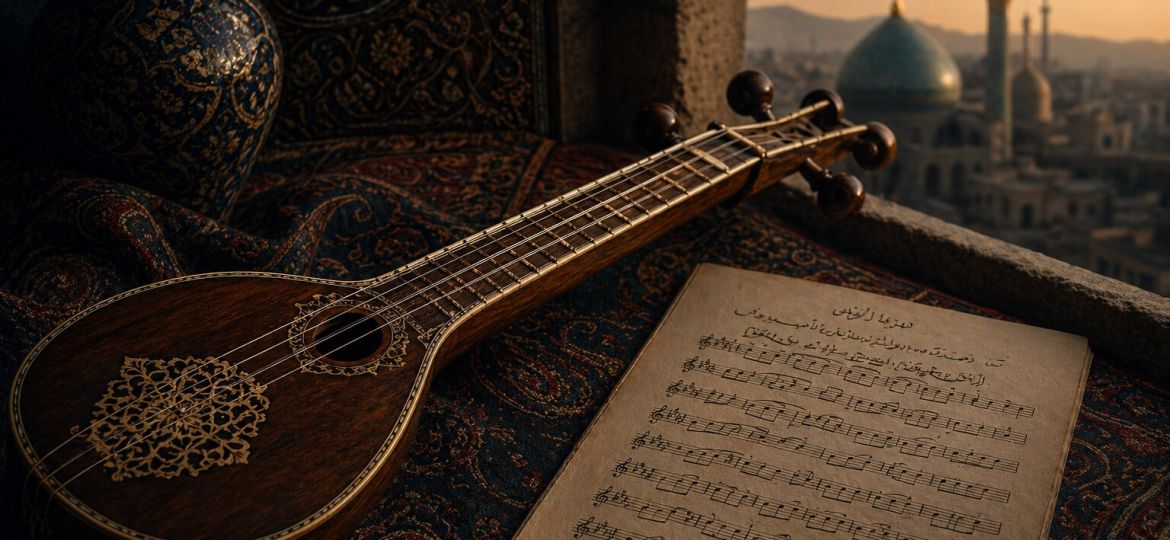
On the Shur mode, fado, and the silences between notes that become the emotional grammar of a novel about inheritance and espionage.
There is a moment in Persian classical music when the Shur mode descends into its lower register and the melody seems to fold inward, as though the instrument has decided to keep something from the listener. It is not a silence exactly – the notes continue – but something in the intervallic structure shifts toward withholding. Anyone who has listened to a tar or setar performance in this mode understands that the music is doing something language cannot easily replicate: it is expressing the shape of a secret.
This quality – the way Persian modal music carries emotional information not through what it plays but through what it declines to resolve – became the structural foundation for my novel Echoes of Shiraz. The book is, on its surface, a dual-timeline literary espionage story spanning 1976 Tehran and contemporary Tel Aviv, Istanbul, and Lisbon. But its real architecture is musical.
The Dastgah System as Narrative Structure
Iranian classical music organizes itself through the dastgah system – a collection of modal frameworks that dictate not just pitch relationships but emotional trajectories. Unlike Western scales, which provide a fixed set of intervals, a dastgah prescribes a journey. It tells the musician where to begin, which notes to linger on, and – crucially – which resolutions to defer.
For a novelist working with family secrets across two generations, this principle offered something more useful than a metaphor. It offered a method. The character of Miriam Cohen-Levi, who arrives in pre-revolutionary Tehran in the 1970s and carries home a secret that will reshape her daughter’s life decades later, needed a narrative framework that could hold unresolved tension across hundreds of pages without demanding premature revelation. The Shur mode, with its characteristic avoidance of tonic resolution, became the template.
Her daughter Shiraz – named for the city, carrying its music in ways she does not yet understand – inherits not just the consequences of her mother’s choices but the modal logic of concealment. She becomes an intelligence operative. She falls in love. The two facts are related in ways the novel takes its time revealing, and the pacing of that revelation follows a musical rather than procedural logic.
Fado and the Portuguese Connection
When the novel travels to Lisbon in its final chapters, a different musical tradition takes over: fado, the Portuguese art of saudade – that untranslatable longing for something absent or lost. Fado and Persian classical music share more than most listeners realize. Both traditions privilege minor tonalities that resist easy emotional categorization. Both use ornamentation not as decoration but as a form of emotional precision. And both understand that the most important note in a phrase is often the one the singer chooses not to sing.
This convergence is not accidental. The historical trade routes that connected Persia to the Iberian Peninsula carried more than silk and spices. They carried musical intervals, poetic forms, and – as scholars of Moorish influence on Iberian culture have documented – entire frameworks for expressing longing. The novel traces these routes not as historical backdrop but as living conduits through which its characters unknowingly move.
Silence as Musical and Thematic Principle
The deepest connection between Persian music and the novel’s architecture is silence. In the radif – the traditional repertoire that forms the basis of Persian classical performance – silences are not pauses between musical events. They are musical events. A skilled performer uses silence the way a calligrapher uses negative space: to define the shape of what surrounds it.
Every secret in the novel is a silence that has learned to carry weight.
Shiraz’s silence about her lover, maintained across months of phone calls that carry an intimacy neither of them names. Miriam’s silence about Tehran, preserved for nearly fifty years. The institutional silence of intelligence agencies, which transform personal withholding into professional methodology. These are not simply plot mechanics – they are the novel’s equivalent of the Shur’s unresolved intervals, held open across the full span of the narrative.
Writing Across Cultures Without Reducing Them
One of the challenges of writing a novel that moves between Iranian, Israeli, Turkish, and Portuguese settings is the temptation to flatten cultural specificity into universalist themes. Music helped me resist that flattening. The Shur does not mean the same thing as a fado melody, even when both express longing. The tar does not function like a Portuguese guitar, even when both instruments occupy similar emotional registers. Preserving these distinctions – letting each musical tradition operate on its own terms within the novel – became a way of honoring the cultural particularity of each setting while allowing the resonances between them to emerge naturally.
This is, I think, what literary fiction can do that genre fiction sometimes struggles with: hold multiple cultural logics simultaneously without resolving them into a single framework. The espionage plot provides momentum. The musical architecture provides depth. And the spaces between them – the intervals, the silences, the deferred resolutions – provide the room in which the reader’s own understanding can develop.
Echoes of Shiraz
A literary espionage novel spanning Tehran, Tel Aviv, Istanbul, and Lisbon — where the distance between a mother's secret and a daughter's mission is measured in music.
Further Reading
Readers drawn to the intersection of music, identity, and cross-cultural narrative may find resonance in the work of authors like Elif Shafak, whose novels similarly weave Turkish and Western cultural traditions; Anthony Doerr, whose attention to sensory experience – particularly sound – as a carrier of meaning in All the Light We Cannot See shares certain structural instincts with this project; and Colm Tóibín, whose prose achieves an interior quiet that mirrors the silences at the heart of his characters’ lives.
For those interested in Persian classical music itself, the recordings of Mohammad-Reza Shajarian remain the essential starting point – particularly his performances in the Shur mode, which demonstrate better than any description the way this modal system transforms withholding into an expressive act.