

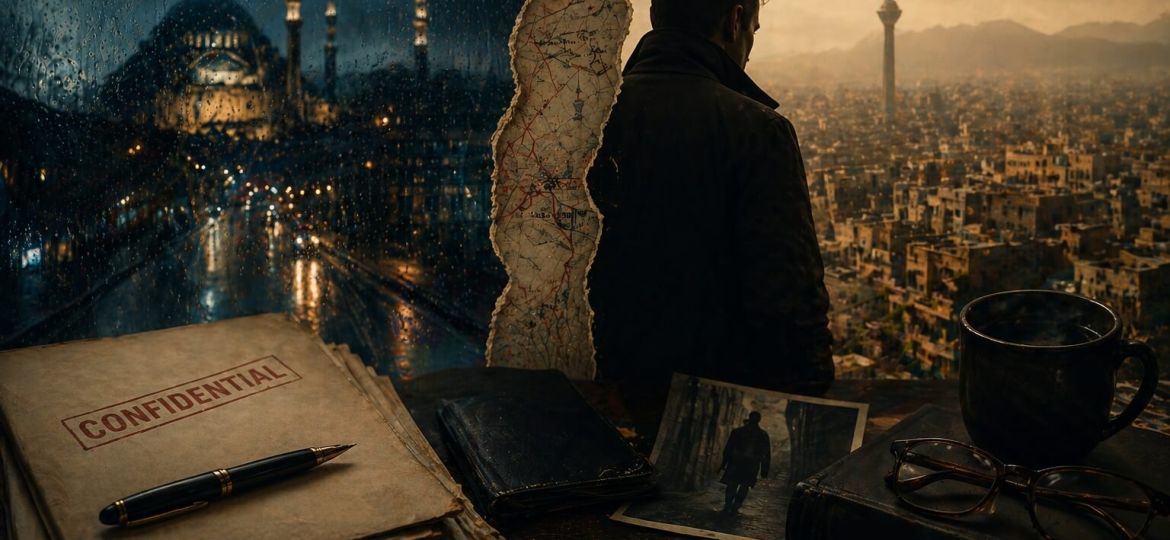
How spy fiction is evolving from Cold War procedurals into something stranger, more interior, and more concerned with what intelligence work does to the people who carry its secrets home.
The espionage novel has always had a literary problem. Its most celebrated practitioners – John le Carré, Graham Greene, Ian Fleming in a different register – established conventions so durable that the genre can feel pre-furnished. There is a handler. There is a mole. There are dead drops, safe houses, and the inevitable scene where the protagonist realizes that the institution they serve has been lying to them. These are powerful tools, and in the right hands they generate extraordinary fiction. But they also create a gravitational pull that can prevent the spy novel from asking the questions literary fiction asks naturally: not “who is the traitor?” but “what does betrayal cost the person who discovers they are its instrument?”
A new wave of espionage fiction is beginning to ask those questions. Novels that retain the architecture of the spy thriller – the operational tension, the institutional paranoia, the carefully managed revelation of concealed information – while subjecting their characters to the kind of interior scrutiny that le Carré himself approached but rarely sustained across an entire narrative. These books are not literary novels that happen to include espionage. They are espionage novels that have decided the genre’s existing tools are insufficient for what they want to say about secrecy, identity, and the families that get caught in between.
The Family as Intelligence Network
The most significant shift in contemporary literary espionage fiction is the relocation of the spy novel’s central metaphor. In classical espionage fiction, the intelligence service functions as a distorted mirror of the state: bureaucratic, compromised, capable of great violence administered through committee. In the newer work, the intelligence service functions as a distorted mirror of the family. Secrets are not state property – they are inherited. Loyalty is not institutional – it is filial. And the cost of operational silence is measured not in geopolitical consequences but in the things a daughter cannot say to her mother across a kitchen table.
My novel Echoes of Shiraz operates at this intersection. Its dual timelines – 1976 Tehran and contemporary Tel Aviv, Istanbul, and Lisbon – are connected not by an intelligence dossier but by a biological fact that one character has kept hidden for nearly fifty years. The espionage plot exists, and it is real: an intelligence briefing, an operational objective, a mission that takes the protagonist from one city to the next. But the espionage plot is also, structurally, the mechanism by which a family secret becomes impossible to maintain. The daughter is sent into the field. The field turns out to be her mother’s past. The tradecraft she has learned – how to withhold information, how to sustain a cover identity, how to love someone without revealing yourself – turns out to be a skill she inherited before any agency taught it to her.
The Problem of Interiority in Spy Fiction
Genre espionage fiction tends to externalize psychology. A character’s inner life is expressed through action: the decision to defect, the choice to burn an asset, the moment of pulling or not pulling a trigger. Literary fiction, by contrast, is comfortable with characters whose most significant experiences are internal – shifts in understanding that may produce no visible action at all.
The best spy fiction has always understood that the most dangerous secret is the one you keep from yourself.
The challenge for literary espionage fiction is to honor both modes simultaneously. An operative’s interior life must be rendered with the same precision that a genre thriller brings to tradecraft, but without sacrificing the operational tension that gives spy fiction its narrative velocity. The prose style matters here as much as the plot structure. A sentence that conveys both the procedural reality of intelligence work and the philosophical weight of what that work requires is doing something neither genre alone demands.
Middle Eastern Settings Beyond Orientalism
Spy fiction set in the Middle East carries additional burdens. The region has been so thoroughly instrumentalized by Western espionage narratives – as a theater of operations, a source of threat, a landscape against which Western moral dilemmas play out – that writing about Iran, Turkey, or Israel in an espionage context requires active resistance to inherited frames. The new literary espionage novel must render these places as they are experienced by the people who live in them: complex, contradictory, possessed of cultural depths that neither Western policy papers nor thriller conventions begin to capture.
In Echoes of Shiraz, Tehran is not a setting for operational sequences – it is a city of gardens, of tar performances in private homes, of a revolution that approaches through changes in the quality of street conversation before it announces itself through politics. Istanbul is not a neutral transit point but a place where Persian, Turkish, and Western cultural logics overlap in ways that the characters must navigate personally, not just operationally. Lisbon, where the novel concludes, is a city whose relationship to longing – encoded in fado, in its maritime history, in the way its light falls on the Tagus in winter – provides the emotional framework for the novel’s final revelations.
Dual Timeline Fiction and the Architecture of Revelation
The dual-timeline structure, which has become increasingly common in literary fiction, serves espionage narrative with particular precision. A spy novel is fundamentally a novel about the management of information – who knows what, and when they come to know it. A dual timeline allows the novelist to create dramatic irony at the structural level: the reader holds information that the contemporary characters do not yet possess, and the tension between those knowledge states generates suspense without requiring the contrivances that single-timeline thrillers sometimes need.
But the dual timeline also creates a deeper structural possibility. It allows the novelist to demonstrate that the past is not simply background for the present – it is an active force, still operating, still producing consequences that the present-day characters experience as fate or coincidence but the reader can recognize as inheritance. When a daughter’s intelligence mission leads her, unknowingly, toward the man her mother loved in a different country under a different political dispensation, the dual timeline is not a narrative convenience. It is the novel’s argument: that the secrets we inherit shape us as surely as the ones we choose to keep.
Where the Genre Is Heading
The most interesting espionage fiction being published now occupies a space that didn’t exist in le Carré’s era – not because le Carré lacked the talent for it, but because the cultural moment didn’t demand it. Contemporary readers come to spy fiction after decades of literary fiction’s attention to identity, diaspora, cultural hybridity, and the intergenerational transmission of trauma. They are accustomed to novels that move between countries and languages, that treat cultural specificity as a form of depth rather than local color, and that understand silence not as a plot device but as a condition of living between worlds.
The literary espionage novel is evolving to meet these readers. It keeps the tension. It keeps the tradecraft. But it asks the tradecraft to carry weight it was never designed for – the weight of family, of cultural inheritance, of musical traditions that encode entire philosophies of loss. When it works, the result is fiction that reads like a thriller and lingers like a poem.
Echoes of Shiraz
A dual-timeline literary espionage novel spanning 1970s Tehran and contemporary Tel Aviv, Istanbul, and Lisbon. Where the distance between a mother's secret and a daughter's mission is measured not in miles but in music, silence, and the things we inherit without being told.
Further Reading
Readers drawn to the intersection of music, identity, and cross-cultural narrative may find resonance in the work of authors like Elif Shafak, whose novels similarly weave Turkish and Western cultural traditions; Anthony Doerr, whose attention to sensory experience – particularly sound – as a carrier of meaning in All the Light We Cannot See shares certain structural instincts with this project; and Colm Tóibín, whose prose achieves an interior quiet that mirrors the silences at the heart of his characters’ lives.
For those interested in Persian classical music itself, the recordings of Mohammad-Reza Shajarian remain the essential starting point – particularly his performances in the Shur mode, which demonstrate better than any description the way this modal system transforms withholding into an expressive act.