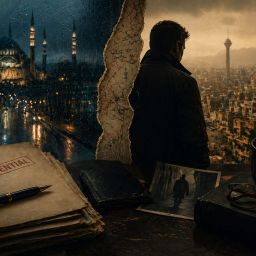

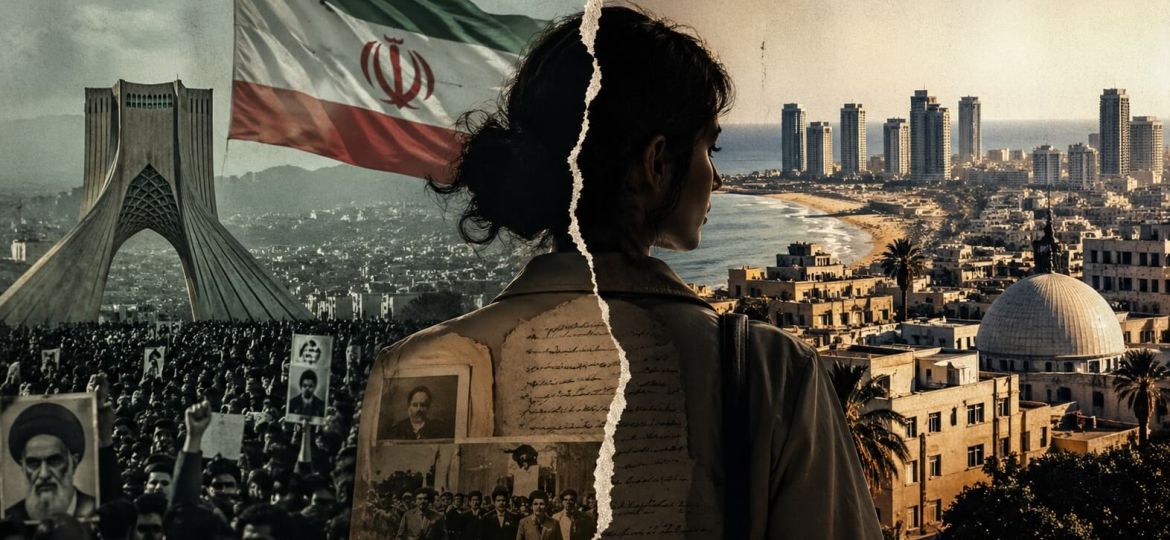
On the literary challenge of capturing the Iranian Revolution – not as political rupture but as the moment when love affairs, friendships, and family loyalties became inseparable from the fate of nations
The 1979 Iranian Revolution is one of the most written-about events of the twentieth century, and one of the least understood – at least by Western audiences – as a lived experience. The political narratives are familiar: the fall of the Shah, the rise of Khomeini, the hostage crisis, the establishment of the Islamic Republic. What these narratives rarely capture is the texture of what the revolution felt like to the people who lived through its approach – the months and years before February 1979, when Tehran was still a city of garden parties and tar recitals and late-night conversations in which the political future was debated with the same intimacy as a family quarrel, because for many Iranians, that is precisely what it was.
Literary fiction has always been better at this kind of texture than history or journalism. A novel can place a reader inside a specific afternoon in 1976 Tehran – inside a room where two people are falling in love while a revolution gathers in the streets below – and make the reader feel both the private intensity of the moment and the historical pressure that will, within three years, make this particular love affair impossible to sustain. The revolution does not need to be explained in a novel. It needs to be felt approaching, the way a change in atmospheric pressure is felt before a storm is visible.
Pre-Revolutionary Tehran: A City in Two Times
The Tehran of the mid-1970s existed in a state of temporal doubling that most historical accounts fail to capture. Under the Shah’s modernization programme, the city was simultaneously ancient and aggressively contemporary – a place where centuries-old bazaars operated in the shadow of new construction projects, where women in Western dress walked the same streets as women in chadors, where SAVAK – the Shah’s feared secret police – maintained a surveillance apparatus modelled on Western intelligence services while the cultural life they monitored retained its distinctly Persian character.
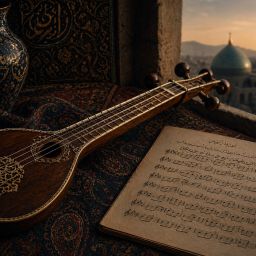
For foreign visitors – diplomats, academics, businesspeople, and the occasional adventurer drawn by Iran’s cultural richness – this doubling created a specific kind of disorientation. The Tehran they inhabited was real, but it existed on borrowed time, and the most perceptive among them could sense the instability beneath the surface modernization. They attended concerts of classical Persian music in which the Shur mode’s unresolved descending phrases seemed to encode something about the national mood. They formed friendships and love affairs with Iranians whose lives were about to be transformed by forces neither party could fully anticipate.
It is this Tehran – intimate, cultured, politically charged, and unknowingly approaching its own transformation – that literary fiction is best positioned to recover. Not the Tehran of news footage and diplomatic cables, but the Tehran of private rooms, of music heard through open windows, of conversations in which everything important was said through implication because directness had become dangerous.
The Jewish-Iranian Experience: A Story Rarely Told
Among the communities most profoundly affected by the revolution – and least represented in Western fiction were Iran’s Jews. The Jewish community in Persia predates Islam by more than a millennium. Persian Jews trace their presence to the Babylonian exile, making theirs one of the oldest continuous Jewish communities in the world. By the 1970s, approximately 80,000 Jews lived in Iran, many of them deeply integrated into Tehran’s professional and cultural life. They were physicians, merchants, musicians, academics. They spoke Persian as their mother tongue. They considered Iran home in the way that only a community with twenty-five centuries of continuous habitation can.
The revolution changed this with a speed that still shocks. Within a decade of the Islamic Republic’s establishment, the Jewish population had dropped to roughly 25,000. Those who left – for Israel, for the United States, for Europe – carried with them a displacement that was qualitatively different from other modern Jewish diasporas. They were not fleeing a country that had never accepted them. They were leaving a country that had been home for longer than most nations have existed, and the grief of that departure contained within it a specific irony: they were, in many cases, going to Israel, a state whose founding mythology centred on a different return from a different exile – but the emotional reality of their arrival was not return. It was loss.
The Persian Jewish diaspora carried not one exile but two: the ancient one they had survived, and the modern one they were living through.
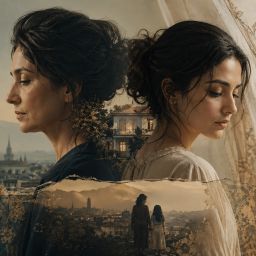
This is the territory Echoes of Shiraz inhabits. Miriam Cohen-Levi, the novel’s older-timeline protagonist, is a woman positioned at the intersection of these identities – connected to Iran through love, to Israel through nationality, and to a secret that binds the two countries in a way no diplomatic relationship acknowledges. Her experience in 1970s Tehran is not simply a love affair set against historical backdrop. It is a collision between personal desire and the geopolitical forces that will, within a few years, make her continued presence in the country untenable – and will transform the private consequences of her choices into a secret she must carry across borders and decades.
Iran and Israel: The Invisible Thread
The relationship between Iran and Israel is, in the popular imagination, defined by hostility – and the post-1979 antagonism is real enough. But this framing obscures a longer and more complex history. Under the Shah, Israel and Iran maintained a robust if quiet partnership. Israeli engineers worked on Iranian infrastructure projects. Iranian oil flowed to Israel through back channels. Intelligence cooperation between SAVAK and the Mossad was an open secret in diplomatic circles. And at the human level, the connections were more intimate still: Iranian Jews who maintained family ties to Israel, Israeli businesspeople who built lives in Tehran, relationships that crossed the national and religious boundaries that the revolution would later make impassable.
For a novelist, this pre-revolutionary connection between Iran and Israel is extraordinarily rich material precisely because it has been almost entirely erased from popular consciousness by the hostility that followed. Most Western readers, if asked about the Iran-Israel relationship, would describe it in terms of nuclear programmes, proxy conflicts, and mutual threats. They would not describe the Tehran of the 1970s, where an Israeli woman and an Iranian man might meet at a concert of classical music and begin a relationship that both countries’ subsequent histories would conspire to make secret.
The erasure of this history is itself a form of silence an institutional and cultural silence that mirrors, at the geopolitical level, the personal silences that the novel explores at the familial level. Nations, like families, maintain secrets. And the consequences of those secrets, like the consequences of a mother’s silence, are inherited by subsequent generations who must live within structures they did not create and cannot fully understand.
The IRGC Generation: Children of the Revolution
The 1979 revolution did not simply end one political order and begin another. It created a new class of people those who came of age within the Islamic Republic’s institutions, whose identities were formed not by the Shah’s Tehran but by the revolutionary state that replaced it. The Islamic Revolutionary Guard Corps, established in the revolution’s immediate aftermath, produced a generation of men whose loyalty, ambition, and self-understanding were inseparable from the institution that shaped them.
In Echoes of Shiraz, this generation is embodied by Dariush Kasravi – a man who entered the IRGC in 1979 and, by the novel’s contemporary timeline, has served within its structures for forty-seven years. Dariush is not a villain in the conventional thriller sense. He is a man whose life has been entirely contained within an institution, and whose personal choices – including a choice made in 1976, before the revolution, before the IRGC existed have been preserved in a kind of institutional amber. The revolution froze certain possibilities. It made certain truths unspeakable. And the novel’s contemporary plot is driven by the pressure those frozen truths exert when, decades later, the ice begins to crack.
Writing characters like Dariush requires resisting the temptation to reduce Iranian institutional figures to ideological caricatures. The IRGC is a real institution with real power and real consequences. But the men within it are also fathers, sons, and in Dariush’s case the keeper of a secret that connects him to an Israeli woman and a daughter he has never met. The literary challenge is to render his institutional reality with accuracy while preserving his human complexity, to show how a revolution can organize a man’s public life completely while leaving his private history unresolved.
The Contemporary Consequences
The most compelling reason to write about the 1979 revolution now – in fiction, in this particular fictional form – is that its consequences have not concluded. The children and grandchildren of the revolution live in its aftermath. The Iranian diaspora carries its inheritance. The Iran-Israel hostility that the revolution inaugurated continues to shape geopolitics, and the human connections that predated it – the marriages, the friendships, the professional collaborations, the love affairs – have been buried under decades of mutual antagonism without being fully extinguished.
A novel set in both 1976 and 2026 can do something that neither historical scholarship nor journalism can easily achieve: it can hold both moments simultaneously, allowing the reader to see the present as the revolution’s living consequence and the past as the present’s hidden origin. The dual timeline is not a narrative device. It is an argument about how history works – not as a sequence of completed events but as an accumulation of unresolved ones, each exerting pressure on the present in ways that the people living in the present can feel but not always identify.
When Shiraz – born in 1977, conceived in Tehran, raised in Israel, named for a Persian city she has never visited – receives an intelligence briefing that will send her toward a man whose father knew her mother in a country that no longer exists in the form it took when they knew each other, the revolution is not history. It is the living structure within which her life is unfolding. She does not need to understand 1979 to feel its effects. She has been feeling them since before she was born.
Echoes of Shiraz
1976 Tehran: a love affair on the edge of revolution. 2026 Tel Aviv: an intelligence mission that leads a daughter into the heart of her mother's secret. A literary espionage novel spanning Iran, Israel, Turkey, and Portugal — where the distance between two countries is measured in the silence between a mother and her daughter.
Further Reading
Readers interested in the Iranian Revolution as literary subject will find essential work in Azar Nafisi’s Reading Lolita in Tehran, which captures the revolution’s effect on intellectual and private life with memoir’s immediacy. Marjan Kamali’s novels explore the Iranian diaspora experience with warmth and precision. Dalia Sofer’s The Septembers of Shiraz addresses the revolution’s impact on Tehran’s Jewish community directly. And for the Iran-Israel dimension specifically, Ronen Bergman’s journalistic work on intelligence history provides the factual framework against which fictional treatments gain their depth.