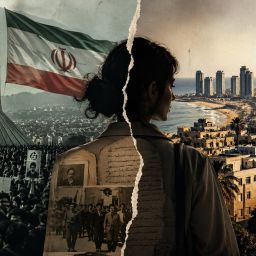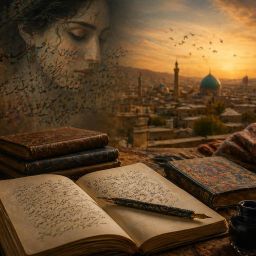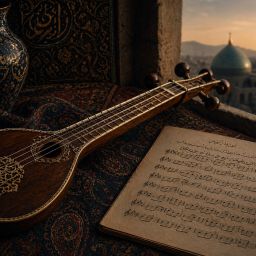

How the Haft-sin table, tahdig, and the rituals of Persian cuisine carry an entire civilization’s memory across borders — from Tehran kitchens to Israeli living rooms, and into literary fiction.
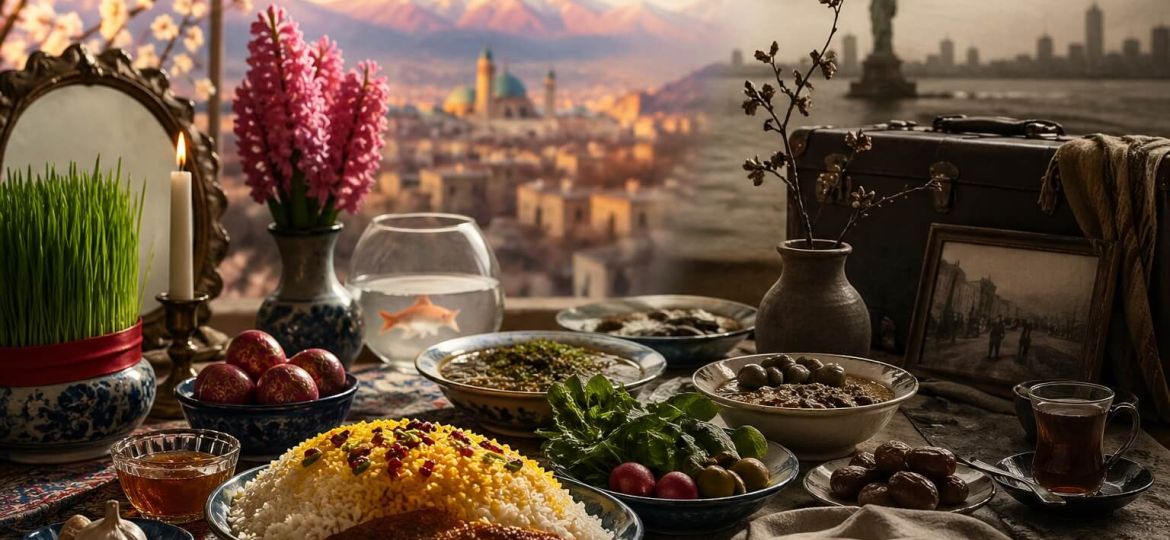
Every March, in apartments across Ramat Gan, Holon, and the older neighborhoods of Jerusalem, a table is set that belongs to another country. Seven items beginning with the Persian letter sin are arranged on a cloth: sprouts of wheatgrass for rebirth, garlic for medicine, dried oleaster fruit for love, vinegar for patience, sumac for sunrise, an apple for beauty, and samanu – a sweet wheat pudding cooked slowly through the night – for affluence and fertility. A mirror stands behind them. A book of Hafez lies open. Goldfish circle in a bowl. And the family gathered around this table speaks Hebrew to its children and Persian to its grandmothers, because this is Nowruz – the Persian New Year, the spring equinox, a celebration that predates Islam by at least a thousand years – and it is being observed in Israel, in the twenty-first century, by people who left Iran decades ago and brought this ritual with them the way they brought their language, their music, and the recipes their mothers taught them by standing beside them in the kitchen and watching.
The Haft-sin table is not nostalgia. It is not a quaint ethnic custom preserved for the grandchildren. It is an act of cultural insistence – a declaration that the civilization you carried out of one country does not dissolve when you arrive in another. And of all the forms this insistence takes among the Iranian diaspora, food is the most durable, the most democratic, and the most emotionally precise. You can lose a language in a generation. Music can be recorded and forgotten. But the smell of tahdig – the golden, saffron-stained crust of rice that forms at the bottom of the pot – is a memory that encodes itself in the body. A child who grows up in Israel eating her grandmother’s tahdig carries Tehran in her senses whether or not she has ever been told anything about the city her family left behind.
The Architecture of a Persian Kitchen
Persian cuisine is among the most sophisticated in the world, and its sophistication is not incidental to its cultural function. Every major dish is a study in balance – the interplay of sweet and sour, of herb and protein, of textures that range from the crunch of fried barberries to the yielding softness of slow-braised lamb. This precision is not merely culinary. It reflects a civilization’s philosophical commitments. The balance of flavors in a well-made ghormeh sabzi – the foundational herb stew of Persian cooking, built on a base of fenugreek, parsley, cilantro, and chives, darkened with dried limes and enriched with kidney beans – mirrors the poetic tradition’s commitment to holding opposing qualities in suspension. Persian poetry does not resolve contradiction. It arranges it. Persian food does the same.
The dishes most central to Persian identity are also the most labor-intensive, which is not a coincidence. Tahdig requires patience and a specific kind of attention – the cook must learn the sound the rice makes when the crust is forming, must develop the nerve to leave the pot on heat past the point where Western cooking instincts would say to remove it. Zereshk polo – jewelled rice studded with barberries, saffron, and sometimes pistachios – demands that each component be prepared separately and assembled in layers. Fesenjan, the pomegranate and walnut stew, thickens over hours, its sauce darkening from auburn to a deep, almost black mahogany. These are not weeknight meals. They are performances, and the knowledge of how to execute them is transmitted not through recipes but through proximity – a daughter standing beside her mother at the stove, absorbing the rhythms before she has language for what she is learning.
Nowruz: The New Year That Refuses to Be Forgotten
Nowruz falls on the spring equinox – typically March 20 or 21 – and its celebration spans thirteen days, from the setting of the Haft-sin table through Sizdah Bedar, the thirteenth day, when families leave their homes and spend the day outdoors, returning the wheatgrass sprouts to running water as a gesture of renewal. The holiday is pre-Islamic, rooted in Zoroastrian cosmology, and its survival through centuries of Arab conquest, Mongol invasion, and Islamic governance testifies to a cultural resilience that no political transformation has managed to extinguish.
In Iran, Nowruz remains the country’s most universally observed celebration – crossing religious, ethnic, and political lines. In the diaspora, it functions differently. It becomes a marker of identity, a calendrical anchor that connects scattered communities to a shared origin. The Iranian Jews who settled in Israel after the 1979 revolution brought Nowruz with them, and its observance in Israeli cities represents one of the most visible examples of Persian cultural continuity outside Iran.
What makes Nowruz’s survival in Israel particularly significant is the cultural context into which it was transplanted. Israel has its own powerful New Year – Rosh Hashanah, observed in autumn – and its own spring holiday, Passover, which carries its own narrative of exile and return. Iranian Jews in Israel thus live within overlapping ritual calendars: the Jewish cycle of memory and the Persian cycle of renewal, each claiming a different season for its most important observance. The Haft-sin table set in a Holon apartment in March is not replacing the Seder table that will be set in the same apartment two weeks later. It is existing alongside it, and the family that observes both is performing a kind of cultural counterpoint – two traditions of memory and rebirth, sustained simultaneously, each enriching the other without diminishing it.
A cuisine is a civilization’s most intimate archive – the one you carry in your body when every other record has been left behind.
Food as the Language That Survives
For diaspora communities, food often outlasts language as a vehicle of cultural transmission. A third-generation Iranian Israeli may speak Hebrew at home, understand Persian imperfectly, and read Hafez only in translation. But she knows tahdig. She knows the smell of saffron dissolving in warm water. She knows that the barberries must be soaked to remove their tartness and then fried briefly in butter with a little sugar. She knows these things in her hands, in her sense of timing, in the instinct that tells her when the rice has steamed long enough – and this knowledge connects her to Tehran with a directness that language, filtered through grammar and conscious recall, cannot match.
This is why food appears in literary fiction not as local color but as a form of characterization. When a novel places a character in a kitchen preparing ghormeh sabzi, the scene is not merely establishing cultural background. It is showing the reader how this character carries her inheritance – in her hands, in the physical memory of a process learned by watching rather than reading, in the specific quality of attention she brings to a task that her grandmother performed in a different country, in a different political reality, under a different sky.
In Echoes of Shiraz, the sensory world of Persian culture – its music, its language, its food – functions as a form of inheritance that operates below the level of conscious knowledge. Characters carry Persian identity in their senses before they understand it as history. A taste, a musical interval, a quality of light that recalls a city never visited – these are the echoes the title refers to, and they are transmitted not through stories told across kitchen tables but through the rituals performed at them.
Saffron, Sumac, and the Spice Routes of Memory
The spices that define Persian cooking – saffron, sumac, turmeric, dried lime, rose water, cardamom – each carry their own history. Saffron, the most expensive spice in the world by weight, has been cultivated in Iran for over three thousand years. The country remains the world’s largest producer, and Iranian saffron is widely regarded as the finest available. When an Iranian grandmother in Ramat Gan dissolves a pinch of saffron in a tablespoon of hot water and pours it over the rice she is preparing for Nowruz, she is participating in a chain of culinary practice that extends back to antiquity – and the golden stain it leaves on the rice is, in a sense, a visible trace of that continuity.
Sumac – one of the seven sin items on the Haft-sin table, representing the colour of sunrise – is endemic to the region stretching from Iran through Turkey to the Levant. Its tart, almost citric flavour appears across Middle Eastern cuisines, but its use in Persian cooking is distinctive: ground fine and sprinkled over rice, kebab, or the raw onion that accompanies grilled meat. Dried limes – limoo amani – are unique to Persian cuisine, used whole in stews where they contribute a complex, slightly fermented sourness that no other ingredient replicates. These are not interchangeable components. They are specific, irreplaceable, and their specificity is part of what they carry. To substitute lemon juice for dried lime in a ghormeh sabzi is not merely a culinary compromise. It is a small act of cultural erosion – the loss of a particular flavour that connects this meal to every previous instance of this meal, stretching back through generations and across borders.
The Nowruz Table in Fiction
A novel that engages seriously with Persian culture must reckon with food – not as a scene-setting device but as a form of knowledge. The challenge for the writer is to render the sensory reality of Persian cuisine with enough precision that the reader can taste it, while also allowing the food to carry the thematic weight it bears in the lives of the characters. A tahdig is never just a tahdig. It is a relationship to patience, to risk, to the particular courage of leaving something on heat past the point of comfort and trusting that the result will be golden rather than burnt. It is a lesson in the difference between caution and care. And it is, for characters who have inherited Persian identity across a generational and geographic divide, a form of communication more reliable than speech – a way of saying I remember where we came from without needing to explain where that was, or why we left, or what it cost us to carry this knowledge into a country that has its own cuisine, its own calendar, its own stories about exile and return.
The Haft-sin table set in an Israeli apartment is a table set twice – once for the family gathered around it, and once for the country they carried out of Iran in their recipes, their music, and their silence. It is, in its way, a form of the same inheritance that Echoes of Shiraz explores through music, through espionage, and through the secrets that mothers keep from their daughters. The table says what the mother cannot: that there is a world behind this one, a world of saffron and sumac and the sound of a tar played in a Tehran garden in 1976, and that world is not gone. It is here. It is in the rice.
Echoes of Shiraz
A literary novel that moves between 1970s Tehran and contemporary Tel Aviv, Istanbul, and Lisbon — where Persian music, food, and silence carry the weight of what one generation cannot say to the next.
Further Reading
For those drawn to the intersection of Persian food and cultural memory, Najmieh Batmanglij’s cookbooks — particularly Food of Life — are definitive references that treat Persian cuisine as the cultural achievement it is. Yasmin Khan’s Saffron Tales explores Iranian food through travel and personal history. For the Iranian Jewish experience in Israel specifically, Galeet Dardashti’s scholarship on Persian Jewish cultural practices offers valuable context. And readers interested in how food functions as literary subject will find rich precedent in the work of writers like Diana Abu-Jaber, whose novels treat Middle Eastern cuisine as a form of characterization rather than ornament.